


Table of Contents
- Understanding Analog Modulation at a Technical Level
- Why Outdoor Laser Projects Demand Analog Modulation
- Analog Modulation and Beam Quality
- Application Example: Newfeel Light N2-A Series
- Control Integration and System Flexibility
- Reliability and Long-Term Operation
- Why Analog Modulation Is the Preferred Choice for B-End Buyers
- Final Perspective
In modern outdoor laser projects, modulation type is no longer a secondary specification. For lighting designers, system integrators, and project owners, analog modulation has become a core requirement, not an optional upgrade.
Whether the application involves landmark illumination, commercial façades, cultural tourism installations, or large-scale outdoor events, the ability to precisely control laser brightness and color behavior determines both visual quality and operational reliability. This is where analog modulation clearly separates professional laser systems from entry-level solutions.
Understanding Analog Modulation at a Technical Level

Analog modulation allows continuous control of laser output intensity across each individual RGB channel. Instead of operating in simple on/off states, the laser diode output can be adjusted smoothly from 0% to 100%.
From an engineering perspective, this means:
Brightness can be scaled precisely rather than switched abruptly
Color mixing occurs gradually, not in discrete steps
Transitions between scenes feel natural and visually coherent
In outdoor environments—where projection distances are long and ambient light conditions vary—this level of control becomes essential. Analog modulation allows designers to fine-tune output so visuals remain clear without appearing harsh or overpowered.
Why Outdoor Laser Projects Demand Analog Modulation

Outdoor laser installations present challenges that do not exist indoors. Large projection surfaces, uncontrolled viewing distances, and changing atmospheric conditions all place higher demands on laser control systems.
Analog modulation addresses these challenges in several critical ways.
First, it enables smooth fades and dynamic brightness shaping, which is essential when transitioning between scenes during nighttime shows. Sudden jumps in brightness, common in non-analog systems, can break immersion and reduce perceived quality.
Second, analog modulation supports true full-color rendering. Outdoor architectural and branding projects rely heavily on accurate color reproduction. Logos, text, and graphic animations require consistent hue balance across red, green, and blue channels. Analog modulation allows this balance to be maintained regardless of output level.
Finally, analog systems offer better visual comfort for audiences. Gradual intensity changes reduce glare and visual fatigue, especially in installations designed for repeated viewing over long periods.
Analog Modulation and Beam Quality
Beam quality is not determined by laser power alone. How that power is controlled is equally important.
With analog modulation, beam edges remain clean even during intensity changes. This is particularly important for outdoor projections where text clarity and animation precision are critical. Smooth modulation ensures that beam diameter, divergence perception, and color saturation remain visually stable throughout a show.
When combined with compressed diode technology and low beam divergence, analog modulation allows outdoor laser projectors to maintain sharp, professional-looking output across long distances.
Application Example: Newfeel Light N2-A Series

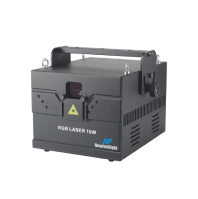
A representative example of analog modulation applied correctly in outdoor environments is the Newfeel Light N2-A Series Outdoor Laser Light Projector.
Designed specifically for outdoor use, the N2-A Series integrates true RGB analog modulation with output options ranging from 3W to 12W. This allows system designers to scale brightness based on project size without sacrificing color accuracy or transition smoothness.
In real-world installations such as commercial building projection, landscape illumination, and outdoor event stages, the analog modulation system enables:
Smooth logo and text animations with no visible stepping
Consistent color gradients across wide projection areas
Controlled brightness levels suitable for both close-range and long-distance viewing
The inclusion of a 40KPPS high-speed scanning system further enhances the benefits of analog modulation, ensuring that complex graphics remain stable and readable even during fast motion sequences.
Control Integration and System Flexibility

Analog modulation also plays a key role in system integration. Outdoor laser projects often involve multiple control protocols depending on the application.
The N2-A Series supports DMX512, ILDA, auto-run, master-slave operation, and mobile app control. Analog modulation ensures that regardless of control method, brightness and color behavior remain predictable and repeatable.
For integrators, this reduces calibration time. For operators, it ensures consistent results across different show modes and environments.
Reliability and Long-Term Operation
Professional outdoor laser installations are expected to run reliably for extended periods. Analog modulation contributes directly to this reliability by reducing thermal stress on laser diodes through controlled output scaling.
Combined with the N2-A Series’ built-in ETC cooling system and IP65-rated waterproof housing, analog modulation supports stable operation under variable weather and temperature conditions. Automatic laser shut-off when signal is lost further enhances safety and system protection.
For B-end buyers evaluating lifecycle cost rather than just initial pricing, these factors are often decisive.
Why Analog Modulation Is the Preferred Choice for B-End Buyers

From a procurement perspective, analog modulation delivers measurable advantages:
Higher perceived visual quality for clients and audiences
Greater creative flexibility for designers
Reduced risk during commissioning and long-term operation
Stronger differentiation in commercial and landmark projects
While simpler modulation systems may reduce upfront cost, analog modulation consistently provides better return on investment in professional outdoor laser applications.
Final Perspective

Analog modulation is not a luxury feature—it is a foundational technology for professional outdoor laser projects.
For lighting companies, production teams, and system integrators working on permanent installations or large-scale events, choosing an analog-modulated laser system is a strategic decision that affects both creative outcomes and operational reliability.
Solutions like the Newfeel Light N2-A Series demonstrate how analog modulation, combined with robust hardware design and flexible control, meets the real demands of outdoor laser lighting at a professional level.
In today’s market, analog modulation is no longer a differentiator—it is the standard.


