


Table of Contents
- What Laser Power Really Means on Stage
- Continuous Lasers vs. Pulsed Lasers
- Why Wattage Alone Doesn’t Define Brightness
- Laser Parameters That Actually Matter
- Average Power vs. Peak Power
- How Laser Power Is Measured in Practice
- Stage Lasers vs. Laser Cutting Systems
- Speed, Scanning, and Motion
- Choosing the Right Laser Wattage
- Why Experienced Buyers Look Beyond Numbers
- Final Thoughts
If you work in professional lighting long enough, you’ll notice one thing very quickly: laser power is one of the most misunderstood specifications in the stage laser market.
Many buyers—especially those comparing multiple suppliers—focus almost entirely on laser wattage. A 10W laser looks better than a 5W laser on paper, and a 20W laser must be twice as bright. In reality, stage laser performance doesn’t work that way.
At Newfeel Light, we speak with lighting companies, rental houses, and event producers every day. What we see again and again is that the best purchasing decisions come from understanding how laser power is actually used, not just how it’s labeled.
This article explains stage laser powers in plain terms, without unnecessary theory, so professional buyers can choose the right system with confidence.
What Laser Power Really Means on Stage

At its simplest level, laser power is expressed as the amount of laser energy a system emits per second. It’s measured in watts, and one watt equals one joule per second. That part is straightforward.
Where confusion starts is when laser power is treated as a direct measure of brightness. In stage lighting, laser power measurement alone does not tell the full story. Two lasers with the same rated power can look very different once they are installed and running in a real venue.
Why? Because laser power only tells you how much energy is available. It doesn’t tell you how that energy is shaped, focused, or moved across the stage.
This is why experienced buyers talk about laser powers as a system-level concept, not just a number on a spec sheet.
Continuous Lasers vs. Pulsed Lasers
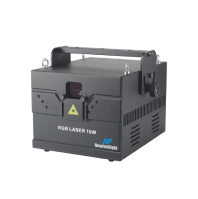
Most professional stage lasers today operate either as continuous systems or as pulsed lasers.
A continuous laser outputs energy at a steady rate. If the system is rated at 10W, it continuously releases 10 joules per second. This type of output works well for stable aerial beams and long, smooth effects.
A pulsed laser, sometimes referred to as a gepulster laser, works differently. Instead of releasing energy constantly, it sends out short laser pulses. Between pulses, energy builds up and is then released in a very brief moment.
Even though the average power stays the same, each laser pulse can reach very high instantaneous output. This is why pulsed systems are often preferred for graphics, logos, and fast-moving animations.
Understanding this difference helps explain why laser peak power can be much higher than the rated wattage. The relationship is often described using a simple peak power formula, where pulse energy is divided by pulse duration.
Why Wattage Alone Doesn’t Define Brightness

One of the most common misunderstandings in the market is assuming higher wattage always means a brighter-looking show. In practice, that’s not always true.
Brightness depends heavily on how concentrated the energy is. A well-designed 8W laser with good optics and tight beam control can easily outperform a poorly engineered 15W unit.
This is where concepts like laser fluence and intensity of laser output become important. When people ask what is fluence in laser systems, the simple answer is this: it describes how much energy is delivered to a specific area.
Higher fluence means the energy is more concentrated, which usually results in stronger visual impact—even at lower wattage.
Laser Parameters That Actually Matter
Professional stage lasers are defined by a set of laser parameters that control how power is used.
Pulse energy determines how much energy each pulse carries. Pulse duration controls how quickly that energy is released. Laser frequency, or repetition rate, defines how many pulses occur per second.
Together, these parameters determine whether a laser looks smooth or flickery, sharp or soft, powerful or underwhelming. Systems with stable laser frequency control and good thermal management maintain consistent output even during long shows.
This is why professional buyers look beyond the headline wattage and ask how the system is engineered.
Average Power vs. Peak Power

Another source of confusion is the difference between average power and peak power.
Average power is what most people think of as laser power—the rated wattage over time. A 10W laser has an average output of 10W, whether it’s continuous or pulsed.
Laser peak power, on the other hand, describes the highest output reached during a pulse. Because laser pulses are extremely short, peak power can reach very high levels, even in mid-power systems.
For stage applications, peak power influences how sharp graphics appear and how visible beams are over long distances.
How Laser Power Is Measured in Practice
Professional buyers often ask how to measure laser power correctly. In real-world conditions, accurate laser power measurement is more complex than placing a meter at the aperture.
Proper high power laser measurement accounts for optical losses, beam alignment, and thermal behavior over time. A reliable system delivers consistent output, not just a high reading during a short test.
This consistency is especially important for rental companies and touring productions, where performance needs to remain stable across many events.
Stage Lasers vs. Laser Cutting Systems

It’s common to see buyers compare stage lasers with industrial systems and ask about laser cutter wattage or laser cutting power vs material.
These comparisons are understandable, but they can be misleading. The laser cutting definition focuses on heat, penetration, and material removal. Stage lasers are designed for visibility, precision, and audience safety.
Because the goals are completely different, industrial laser specifications don’t translate directly to entertainment applications.
Speed, Scanning, and Motion
Questions like how fast are lasers or how fast is a laser come up frequently. The speed of light itself doesn’t change. What matters is how fast the scanning system can move the beam.
The perceived speed of laser effects depends on scanner quality and control algorithms. Good scanners allow fast movement without sacrificing brightness or stability, which is essential for modern shows.
Choosing the Right Laser Wattage

Selecting the right laser wattage depends on many factors: venue size, viewing distance, ambient light, and creative goals.
Smaller indoor venues often don’t need extreme power. Larger stages and outdoor environments usually require higher output, but only when combined with proper optics and control.
Rather than asking how hot are lasers or chasing the biggest number, professional buyers focus on usable performance.
Why Experienced Buyers Look Beyond Numbers
Terms like laser value or laser number don’t tell you much about how a system will perform on site. What matters is engineering quality, stability, and honest specifications.
At Newfeel Light, we believe the best systems are the ones that deliver predictable results night after night. Understanding laser power, laser energy, and how that energy is controlled allows buyers to make smarter, more confident decisions.
Final Thoughts
Understanding stage laser powers doesn’t require advanced physics. It requires practical knowledge of how laser systems behave in real environments.
When buyers understand how laser pulses, laser fluence, and key laser parameters work together, they can move past marketing claims and focus on performance that actually matters.
In the end, the right laser isn’t just the most powerful one—it’s the one that performs consistently, looks great on stage, and fits the demands of professional production.


