


Table of Contents
- 1. Technical Foundations: The Science of High-Impact Visuals
- 2. Global Standards: Matching Venue Scale to Laser Power
- 3. Spatial Architecture: Reimagining the Concert Experience
- 4. Case Study: Xu Liang at Shenzhen Bay Sports Center
- 5. Procurement Guide for Engineering Contractors
- Conclusion: Ignite Your Next Production
In the professional production landscape of 2026, concert audiences no longer settle for mere illumination. We have entered the era of the "Precision Visual Strike." Today’s top-tier stadium production design is about surgical accuracy—using light not just to fill a space, but to redefine its physical boundaries.
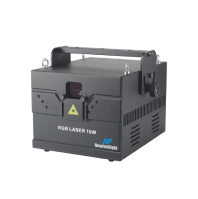
As a leading stage lighting manufacturer, we’ve seen the shift: the demand has moved from "quantity" to "impact." At the center of this revolution is the high-power stage laser, a tool that offers the contrast and intensity required to dominate the massive visual noise of modern LED-heavy stages.
1. Technical Foundations: The Science of High-Impact Visuals
To achieve a "precision strike," a laser stage lighting projector must meet three industrial-grade benchmarks. In a stadium environment, anything less is a liability.
High-Speed Scanning (35K - 40K PPS)
Synchronization is the heartbeat of a concert. To trace intricate rhythmic patterns without flickering, scanners must move at 35K to 40K PPS. While low-end 15K PPS scanners create distorted lines, professional systems ensure every laser hit is perfectly synced to the beat.

Beam Precision (< 1.2 mrad)
In a 10,000-seat arena, distance is the enemy. A high-power stage laser with a divergence of < 1.2 mrad ensures the beam remains sharp across a 200-meter throw. If the divergence is too high, the beam turns into a blurry "flashlight" before reaching the audience.

Environmental Protection (IP65)
Outdoor stadium shows are unpredictable. Industrial-grade equipment must feature an IP65 waterproof rating and active TEC thermal management to ensure 100% stability during a 4-hour high-intensity performance.
2. Global Standards: Matching Venue Scale to Laser Power
A critical step for Engineering Contractors is selecting the correct wattage based on the venue's square footage and light pollution levels. Using an underpowered unit in a massive arena leads to "visual drowning."
International Venue-to-Wattage Recommendation Matrix
| Venue Type | Square Footage (㎡) | Capacity(people) | Recommended Main Laser Power |
| Indoor Theater / Club | 1,000 - 3,000 | 800 - 2,500 | 10W - 15W |
| Exhibition Hall / Arena | 5,000 - 15,000 | 3,000 - 8,000 | 20W |
| Outdoor Stadium (Medium) | 20,000 - 50,000 | 10,000 - 15,000 | 30W |
| National Stadium / Landmark | 50,000+ | 30,000+ | 40W+ |
3. Spatial Architecture: Reimagining the Concert Experience
With 30W/40W power, stage designers can move beyond simple effects to create complex spatial art:
Beams & Fans (Spatial Cutting): Using 30W units as the visual core to create a "forest of light," physically partitioning the stadium.

Liquid Skies (Atmospheric Layers): Projecting flat planes of light just above the audience, creating a surreal "ceiling."

Laser Mapping: Precision-tracing the stage's structural bones, transforming static trusses into glowing art.

The Logic of Atmospheric Ignition
Instantaneous Burst: When 30W main lasers sync with 10W auxiliary units at a musical climax, the visual tension far exceeds ordinary lighting.
Light & Dark Rhythm: Utilizing high color contrast to create sharp focal points in dark-field transitions.
The Stadium Reality: In a 10,000+ seat venue, any laser under 30W loses its "cut" against the massive LED screen wash.

4. Case Study: Xu Liang at Shenzhen Bay Sports Center
When the L (Xu Liang) concert tour arrived at the Shenzhen Bay Sports Center (Spring Cocoon)—a massive venue covering 48,000 square meters with a capacity of 10,000 fans—the stage production team required a visual soul that could keep pace with his rhythmic complexity.
The Hardware Configuration:
To dominate this 48,000 $m^2$ space, the production utilized an uncompromising setup:
6 x 30W Full-Color RGB Lasers: Serving as the primary "strike" units for long-distance beam dominance.
40 x 10W Full-Color RGB Lasers: Deployed to create high-density spatial meshes.
32 x LaserBars & 6 x Custom Matrix Lasers: Used for intricate geometric stage framing.

The 30W main lasers acted as the visual anchors, cutting through the stadium’s ambient light. By utilizing 35K-40K PPS scanners, the design achieved frame-perfect sync, transforming the static stadium into a dynamic, glowing grid.
5. Procurement Guide for Engineering Contractors
For Professional Rental Houses and Engineering Contractors, the decision to invest in high-power equipment is a balance of ROAS (Return on Asset Spend) and battlefield reliability.

The Contractor’s Critical Checklist:
Stability & IP Rating: Ensure the unit is IP65 rated for outdoor durability.
Optical Specs: Verify the < 1.2 mrad divergence for beam coherence.
Control Protocols: Integrated FB4 is the standard for remote network management (Fiber/CAT6) in large venues.
30W System ROI Analysis
| Investment Factor | Professional 30W System | Low-Cost Generic Unit |
| Rental Tier | A-List Stadium Riders | Small Club / Private Party only |
| Maintenance | Low (Industrial TEC) | High (Frequent Diode Burnout) |
| Resale Value | High (Retains relevance) | Low (Rapidly depreciates) |
Conclusion: Ignite Your Next Production
In 2026, the difference between a good show and a legendary one is the precision of the visual hit. As a dedicated stage lighting manufacturer, we provide the hardware that allows visionaries to dominate the largest venues on earth.
Ready to redefine your stadium production design? [ Contact us today for a customized technical layout and wholesale pricing. ]


