


Table of Contents
- What Is a Light Beam in Stage Lighting?
- Laser Beam Meaning from a Technical Standpoint
- Beam Control: Precision vs. Coverage
- Application Differences in Real Productions
- Environmental Dependency: Why Lasers Behave Differently
- System Design Considerations for Professionals
- Laser Light Show Design: Engineering Meets Art
- Conclusion: Choosing the Right Beam for the Job
In professional event production, the conversation around lighting quality often starts with output power or fixture brand. But experienced designers know that the real difference between a compelling visual system and an average one usually comes down to how the beam itself behaves in space.
Understanding the difference between a laser light beam and a conventional light beam is essential when designing club lighting, concert lighting, and large-scale live productions. These two technologies are fundamentally different—not just in appearance, but in physics, control behavior, and practical application.
This guide breaks down those differences from a technical standpoint, helping lighting professionals make better system-level decisions rather than relying on marketing terms alone.
What Is a Light Beam in Stage Lighting?

From an engineering perspective, a light beam refers to a directional projection of light produced by conventional sources such as LED emitters, discharge lamps, or tungsten filaments. When professionals ask “what is a light beam?”, the answer lies in how light spreads after leaving the source.
A standard beam of light contains a wide spectrum of wavelengths. Even when optics focus it tightly—as in a moving head or stage spotlight—the light remains incoherent. Each wave travels independently, which causes natural divergence as distance increases.
This is why a red light beam from an LED fixture looks bright near the source but softens over distance. The beam expands, intensity drops, and edges lose definition. In practical terms, this behavior is actually beneficial for many applications.
Conventional light beams excel at:
Area illumination
Color washes
Texture projection using gobos
Front light and camera-friendly exposure
That’s why traditional moving lights stage systems remain the backbone of most event lighting designs. They create visibility, depth, and comfort—especially in environments without atmospheric effects.
Laser Beam Meaning from a Technical Standpoint

A laser beam, by contrast, is governed by entirely different physical rules. The laser beam definition is rooted in stimulated emission, producing light that is coherent, monochromatic, and highly directional.
In practical terms, a laser light beam differs from ordinary light in three critical ways:
First, coherence. All photons in a laser beam travel in phase. This synchronization allows the beam to maintain structure over long distances without breaking apart.
Second, monochromatic output. A laser emits an extremely narrow wavelength band. This purity is what gives laser colors their saturated appearance and why a green or red laser beam cuts through ambient light so effectively.
Third, minimal divergence. While conventional light beams widen rapidly, a laser beam spreads only fractions of a degree. In haze-filled environments, this creates the iconic mid-air lines that define modern laser light show design.
This explains the fundamental difference between laser light and ordinary light. Ordinary light fills space. Laser light defines it.
Beam Control: Precision vs. Coverage

From a control standpoint, lasers and conventional beams serve different design purposes.
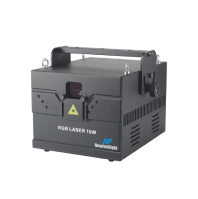
A laser light beam allows exact positional control. Modern laser projectors can draw vector-based graphics, text, and logos with mathematical precision. This is why lasers are used for branding moments, countdowns, and signature visual cues.
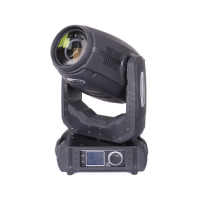
A conventional light beam, even from a high-end LED moving head, trades precision for coverage. It spreads light intentionally to create mood, texture, and visibility. When designers ask about the light the beam meaning, this distinction is critical: beams from LEDs are meant to shape space, not define lines.
In professional systems, the two technologies should complement—not replace—each other.
Application Differences in Real Productions
In club lighting environments, lasers often act as the visual “accent layer.” A laser beam system delivers sharp geometry above the crowd, while moving head washes and spots handle general illumination.
In concert lighting, lasers are frequently used for impact moments. A single laser light beam sweeping across a stage can feel more dramatic than multiple conventional fixtures—precisely because of its contrast and focus.
By comparison, traditional light beams dominate in scenarios where audience comfort and visibility matter most. Corporate events, theatrical productions, and broadcast environments rely on controlled, diffuse light rather than intense aerial effects.
This is why understanding the difference between ordinary light and laser light is less about choosing one over the other, and more about assigning each tool to the right role.
Environmental Dependency: Why Lasers Behave Differently

One of the most misunderstood aspects of laser systems is their reliance on atmospheric conditions. A laser beam does not become weaker without haze—it simply becomes invisible in air.
Without particles to scatter light, the beam path disappears, leaving only the impact point visible. This often leads inexperienced users to assume a laser lacks power, when in reality the environment lacks reflectivity.
Conventional beams do not have this limitation. Even without haze, a beam of light from an LED fixture remains visible because it illuminates surfaces rather than relying on mid-air scatter.
This environmental dependency is a defining factor in professional system design.
System Design Considerations for Professionals

From a technical planning standpoint, lasers should be specified based on:
Beam divergence and scanner speed
Control protocol compatibility
Safety features and compliance
Intended viewing distance and environment
Conventional beam fixtures should be evaluated based on:
Optical efficiency
Zoom range
Color mixing quality
Thermal stability and duty cycle
A balanced lighting system uses both technologies intentionally. Lasers deliver definition and impact. Conventional beams deliver volume and atmosphere.
Laser Light Show Design: Engineering Meets Art

At the highest level, a professional laser light show is less about brightness and more about control accuracy. Scanner precision, modulation depth, and color linearity determine whether graphics look sharp or distorted.
Meanwhile, conventional lighting builds the foundation that makes those laser moments readable. Without proper wash and spot layers, even the most advanced laser system will feel disconnected from the space.
This is why experienced designers think in layers, not fixtures.
Conclusion: Choosing the Right Beam for the Job
The debate between laser light beam vs. light beam is not about superiority—it’s about application.
Laser beams offer unmatched precision, minimal divergence, and visual authority. Light beams offer coverage, comfort, and adaptability. Understanding how each behaves allows professionals to design lighting systems that feel intentional, controlled, and technically sound.
For lighting companies, event producers, and system integrators, mastering this distinction is not optional. It’s the difference between lighting that merely fills a room and lighting that defines an experience.


